The Second World War - German Tanks Of Ww2 - World War Two - German Tanks
Panzerkampfwagen I |
|
The Panzer I was originally intended as a training tank but saw front line service up until 1942. The limitations imposed on Germany after the First World War made it necessary to hide the real purpose of the vehicle so it was called the Landwirtschaftlicher Schlepper (La S) or agricultural tractor until 1938 when the designation Panzer I (PzKpfw 1) was used. The first variant (Ausf A) weighed only 5.5 tonnes (6.06 US tons), had a two man crew and was armed with two 7.92 mm (0.31") machine guns in a small turret. The main production version (Ausf B) had a more powerful engine and was slightly longer. |
|
The Panzer I first saw action with the German Condor legion during the Spanish Civil War between 1936 and 1938. The Panzer I saw extensive service during the invasion of Poland in 1939 and France in 1940; but by 1941 the Panzer I was being withdrawn from the battle tank role. There were numerous variants based on the Panzer I chassis: command vehicles had a large fixed superstructure in place of the turret; a self-propelled artillery vehicle was fitted with a 15 cm (5.91") infantry howitzer; a few chassis were converted to flame throwers; and an anti tank vehicle, the Panzerjäger I, was armed with a 47 mm anti-tank gun. |
Panzerkampfwagen II |
|
The Panzer II was larger than the Panzer I, had a three man crew and was armed with a 2 cm (0.79") cannon. The Panzer II was also intended to be a training tank but, like the Panzer I, entered service as a battle tank due to delays in delivering the Panzer III and IV. The first Panzer II's were engaged in action in the Spanish Civil War. The first model to be produced in numbers was the Ausf D. The Ausf E, employed an entirely new hull, suspension and armoured layout. The last model, the Ausf F, was still being produced until 1943.The Panzer II was fast and ideal for the new concept of Blitzkrieg put into practice during the German offensives of 1940-42. After the Pz II had become ineffectual as a battle tank it too was adapted for many other roles including a flame throwers and bridge layers. The Marder II and Wespe self-propelled guns were new developments that utilised Pz II technology. |
 |
|
The final model of the Pz II series was the Ausf F. The front hull of the Ausf F was made from one flat 35mm plate instead of the rounded hull of previous versions. The front of the superstructure was redesigned with one flat 30mm plate extending across the width of the hull with a dummy visor fitted on the right-hand side. The suspension incorporated a new conical design for the idler wheel. The turret front plates and gun mantlet was increased to 30mm and featured an eight-periscope cupola for the commander. |
|
The Luchs (Lynx) was the result of an order issued on the 15th of April 1939 that called for a fully-tracked armoured reconnaissance vehicle. Production began in August 1942 The chassis was developed by MAN and Daimler-Benz designed the superstructure and turret. The prototype was completed in April 1942. The initial order was for 800 vehicles, the first 100 being equipped with the 20mm KwK38 and the remainder (designated Leopard) with the 50mm KwK 39/1 L/60. No Leopards were ever produced; a decree issued in January 1943 ordered that production cease after the first 100 Luchs had been completed. The Lynx had a crew of 4 and, unlike the other versions of the Pz II, used overlapping road wheels with torsion bar suspension. |
Panzerkampfwagen 35 |
|
The Panzerkampfwagen 35(t) was a Czech main battle tank that was taken into service by the German army after the provinces of Bohemia and Moravia were annexed in March 1939. It remained in service for more then three years. |
|
It was a very advanced design for its time but was technically complex making it prone to mechanical failure. It utilised a pneumatically operated transmission, rear sprocket drive, small road wheels and wide tracks; innovations that would feature on armoured vehicles designed much later in the war. Steering and transmission were mechanically assisted using compressed air but this system proved to be very problematic, especially during the freezing temperatures of the Russian winter. |
|
The armour was between 8mm to 50 mm thick and was riveted together rather than welded. The main gun was a 37 mm KwK 34(t) L/40 operated by the tank commander. Secondary armament consisted of two 7.92 mm MG34 or MG35/37(t) MG's, one mounted in the hull and one mounted coaxially in the turret. |
Panzerkampfwagen 38 |
|
The Czech LT Vz38 was intended as a replacement for the LT-35, which was considered to be technically too complex. On July 1st 1938 an order was placed for 150 but none had been delivered before the annexation of Czechoslovakia. After the annexation the Wehrmacht recognised the T38 as being an excellent tank and ordered that production continue. The Germans modified the design by adding an extra crewman to load the gun, reducing the commanders workload considerably. To make room for the loader 18 rounds of 37mm ammunition were removed. |
|
Experience during the Polish campaign revealed a need for better protection and the armour was subsequently increased all round. The frontal armour was increased to 50mm by the simple expedient of riveting two 25mm plates together. Other improvements were made including new visors for the driver and radio operator, an internal ball mount for the hull machine gun and a reduction in the amount of riveting. |
|
A modified Panzer 38(t) chassis was the basis for a number of self-propelled guns and tank destroyers, including the very successful Jagdpanzer 38 Hetzer tank-destroyer that mounted the 7.5 cm PaK 39 L/48 gun. |
Panzerkampfwagen III |
|
By 1935 a more advanced vehicle was being planned, based on experience gained from the the Panzer I and II. The plan that evolved was to produce two tanks: a main battle tank to engage the enemy tanks and a heavier tank for infantry close support. The main battle tank eventually became the Pz III; .armed with a 3.7 cm (1.46") main gun and a co-axial machine gun mounted in a revolving turret and a single machine gun in the hull that was used by the wireless operator. It had a crew of five: commander, gunner, loader, driver and a radio operator. The design was subject to major improvement over time being equipped with bigger guns and thicker armaments resulting in over 20 versions of the basic design. The original 3.7cm gun was replaced by a 5.0cm gun and then a 7.5cm gun, the same as fitted to the early Pz IV.. During the early parts of the war the Panzer III's formed the bulk of the Panzer Divisions strength but there was never enough of them to the extent that the shortfall had to be made up with Czech T35 tanks. The Pz III was at a serious disadvantage when facing other allied tanks, especially the Russian T34 and manufacture ceased in 1943. As with other vehicles the Panzer III chassis was the basis for a number of variants and conversions. |
|
|

Panzerkampfwagen IV |
|
At the outbreak of World War Two there were only a small number of Panzer IV's in service. The design was originally intended to fulfil the heavy close support role, being armed with a short 7.5cm howitzer, but the Panzer IV eventually swapped roles with the Panzer III and became the main battle tank of the Panzer Divisions until the introduction of the Panther later in the war. The Panzer IV had a five-man crew: Commander, Gunner, Loader, Driver and Radio Operator. The crew communicated using an internal intercom system, an innovation at the time; and one that was probably a significant factor in the early success of the Panzer Divisions. |
 |
|
From the Ausf F onwards the Panzer IV was equipped with a long 7.5 cm gun and thicker armour. Subsequent versions utilised extra skirt armour and spaced armour to defend against hollow charge anti-tank weapons. The design continued in production until the end of the war. |
|
The chassis was used as the basis for many variants:
|
Panzerkampfwagen V (Panther) |
|
The Russian T34 came as a shock to the German panzer troops: well protected with sloped armour, a 7.62 cm (3") main gun, powerful diesel engine and wide tracks that enabled it to cross terrain impassable to the German tanks; the T34 held the cards in most head on tank vs. tank scenarios against the Pz III and Pz IV. The German response was the Panzerkampfwagen V, more commonly known as the Panther tank. Technically it was impressive but it was rushed into production during the early part of 1943 and consequently suffered from teething troubles. Armed with an excellent 7.5cm (2.96") KwK 42 L/70 main gun and fitted with thick sloped armour it was capable of taking on just about any allied tank at the time. The overlapping road wheels reduced the ground pressure significantly but changing one of the inside wheels necessitated removing up to five other wheels in front of it. During the battle of Kursk many vehicles broke down before they entered the action, some vehicles burst into flames due to faulty fuel lines. Later versions of the vehicle were fitted with infra red equipment to enable them to fight at night, thus evading the danger of allied fighter bombers. The Panther evolved into an efficient weapons system but there simply weren't enough to make any difference to the outcome of the war. |
 |
Panzerkampfwagen VI (Tiger) |
|
|
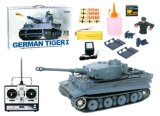
In 1937 the German Army weapons branch issued a specification to Henschel for a heavy tank weighing between 30-33 tons. It was intended to fulfil the role of 'infantry close support' and was to mount the same short 7.5cm howitzer as the Panzer IV. The specification was changed several times, the most significant being the decision to use the a version of the 8.8cm anti-aircraft gun. A design, known as the Tiger tank, finally went into production in August 1942 continuing until August 1944 resulting in 1,355 being built. The Tiger was a costly vehicle to build but it's size, thick armour and 8.8cm gun meant that it could totally outclass anything that the allies could put onto the field. |
|
|
The Tiger was committed to action before any useful numbers could be produced and before it had been properly tested. The first engagement was near Leningrad where a platoon of four Tigers unsuccessfully attempted to break the Russian defences, breaking down in the process. Several variants were produced including a heavy assault mortar, command vehicles and recovery vehicles. |
|

 |
Panzerkampfwagen VI (Tiger II) |
|
The Tiger II was armed with a long 8.8 cm (3.47") gun and was fitted with thick sloped armour making it one of the most powerful main battle tanks of World War II. It was a very heavy tank and consumed huge quantities of fuel, which seriously limited its battlefield mobility and performance. Also know as the King Tiger or Royal Tiger the vehicle was issued to special Panzer units of the Army and SS. Production began in early 1944 but just less under 500 had been produced by the end of the war. The Tiger II participated in a few notable actions such as the Ardennes offensive in 1944, but generally they didn't contribute greatly to the German war effort. |
 |
Self Propelled Guns |
 |
 |